
-
-
St. Nicholas ChuRch is HOME TO THE MAXO VANKA MURALSExplore the powerful story behind these one-of-a-kind murals and how they came to be from the devoted priest that sought the artist to capture the faith, struggle, and spirit of Pittsburgh’s Croatian immigrant community.
-
-
-
Take the Murals home with you with this DVD!Enjoy this documentary of Maxo Vanka's Masterpiece anytime you want a guided tour of the murals, learn of their meanings, learn about the artist and the priest that made them a reality, and what the murals mean to Parishioners Maxo Vanka's Masterpiece: The Murals of St. Nicholas Church
-
-
-
How the Murals Came to Be
To tell the story of the murals, is to begin with their origins of how a priest, Father Albert Zagar, sought out a fellow Croatian, artist Maksimilijan "Maxo" Vanka, and how their uncanny friendship, mutual admiration, and trust resulted in a profound spiritual tribute to the bible and plight of the Croatian immigrant in 1930s America.
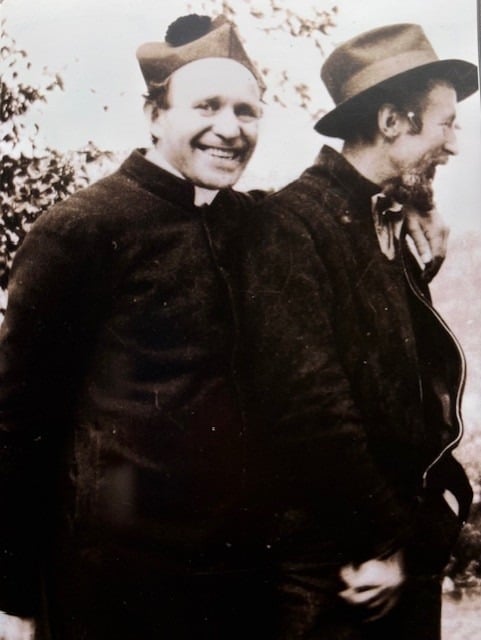 Father Zagar (left) and Maxo Vanka (right)Following a fire in 1921, St. Nicholas Church was rebuilt in 1922 under the guidance of its original architect, Federick Sauer. In 1931, Father Zagar assumed his role as Pastor and, after resolving the church’s debts, turned his attention to its unadorned walls, which had remained white for approximately fifteen years. Guided by artistic sensibility and intellectual curiosity—Father Zagar fluently spoke nine languages and held progressive ideals—he approached the Croatian immigrant community for an artist who could produce murals resonant with their shared experiences.
This outreach eventually reached Louis Adamic, a notable Slovenian-American author and editor known for chronicling the immigrant journey. Living in New York at the time, Adamic received Father Zagar's request for help contacting Croatian artist Maksimilijan “Maxo” Vanka, whose work Father Zagar had encountered at a Pittsburgh exhibition at the Wunderly Brothers Gallery in May 1935. Father Zagar was credited with saying about Vanka, "When I heard of Maxo Vanka, the artist - one of our people, a Croatian living in New York - I immediately sent him a wire.
Father Zagar, after being connected to Vanka, did send a prompt wire invitation: “Come Friday! Come Sunday!” Vanka responded immediately, visiting Millvale and developing a strong admiration for Father Zagar’s integrity and directness. Adamic recollected that Vanka regarded Father Zagar as a “true follower of Saint Francis of Assisi.” Vanka was assured complete artistic autonomy, provided some works reflected religious subjects—a notably progressive stance for church art at the time.
Upon arrival in Millvale, Father Zagar informed reporters, “We want murals that would tell the story of this parish, of the people.” Thus, in two major campaigns in 1937 and 1941 (in a total of 24 weeks), plus a final visit in 1950 to complete the paintings on the front of the organ loft and add Croatian folk trim, Vanka produced murals depicting biblical scenes and honoring the contributions of Croatia
 Father Zagar watches Maxo Vanka paint the "Croatian Family Meal" in 1941n immigrants to American society and industry. These works also included satirical critiques of capitalists, reflecting the sociopolitical climate of the era.
Vanka’s murals illustrate the lives of Croatian peasants who, between 1880 and 1920, left their homelands seeking opportunity in industrial America in response to economic hardship and political oppression. The challenging content further expressed Vanka’s convictions regarding the futility of war and the heartbreak caused by his homeland’s destruction.
Having immigrated to the United States in the 1930s, Vanka drew upon his experiences to imbue these murals with powerful reflections on spirituality, humanity, history, social justice, and politics. He also highlighted the deep reverence Croatians hold for motherhood—not merely the earth itself, but the women who labor upon it. This theme is especially prominent in several works, including “Croatian Mother Raises Her Son for War,” “Immigrant Mother Raises her Son for American Industry,” "Mati," and most notably the imposing thirty-six-foot Madonna and Child above the altar, inscribed in Croatian: “Marijo-Kraljice Hrvata-moli za nas,” or “Mary, Queen of Croats, Pray For Us.”
Father Zagar’s vision and courage were commended by Vanka, who stated, “Father Zagar was one priest in one hundred thousand courageous enough to break with tradition, to have his church decorated with paintings of modern, social meaning.” As a mark of esteem, Vanka included Father Zagar in a mural be
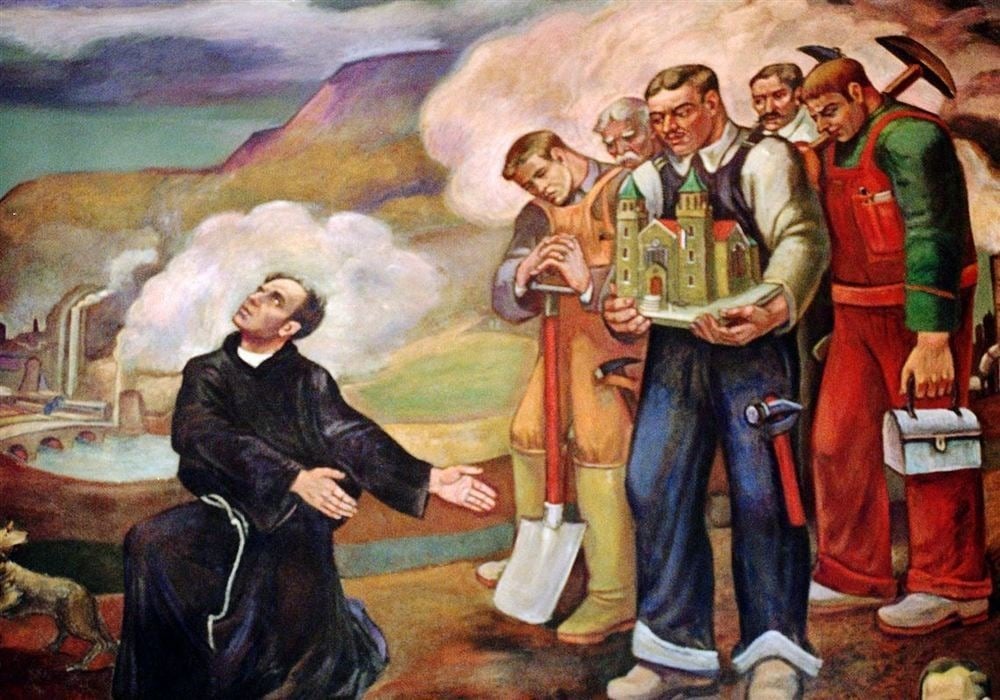 Immigrant Workers Presenting St. Nicholas Church to the Virgin Known as the "Croatians in the New World" (1937)hind the altar titled “Immigrant Workers Presenting St. Nicholas Church to the Virgin.”
Upon completion, Vanka declared, “These murals are my contribution to America—not only mine, but my immigrant people's, who are grateful, like me, that they are not in the slaughter of Europe.”
Known today as the Vanka Murals, these works, combined with the historic status of St. Nicholas Church as the first building in America purposely built as a Croatian Catholic Church, were recognized with a listing on the National Register of Historic Places as well as a designation as a Pittsburgh Historic Landmark in 1980. They established a lasting legacy born of collaboration between two immigrants, commemorating their shared respect and recounting the broader narrative and faith of many.
Check Out Father Zagar's Photo Album of the Murals View Our Tribute to Father ZagarABOUT MAXO VANKA (1890-1963)
 Maxo Vanka with a sparrow he befriended while painting the murals.Maksimilijan "Maxo" Vanka was born on October 11, 1889, in Zagreb, Croatia, and is believed to have been the illegitimate child of Austro-Hungarian nobility. He was raised by Croatian peasants until the age of eight, after which, from 1897 to 1912, a benefactor enabled him to live an aristocratic lifestyle and receive advanced education and training in the arts. In 1915, Vanka became an officer in the Belgian Red Cross during World War I. Between 1920 and 1926, he served as a professor of Arts and earned numerous awards for his artistic accomplishments.
 Maxo Vanka painting "Christ on the Battlefield" 1941
In 1934, Vanka emigrated to the United States. He married Margaret Stetten in 1931, and their daughter Peggy was born in 1932. During his time at his summer residence on the island of Korcula, he formed a close friendship with Louis Adamic, a Slovenian born writer. From 1921 to 1934, Vanka held exhibitions throughout Europe, ultimately relocating to New York City by the end of 1934. Through Adamic, he was introduced to Father Zagar, which led to the 1937 commission of the first series of 25 murals at St. Nicholas Church. Within eight weeks during the spring of 1937, Vanka completed 11 paintings.
 Maxo Vanka painting Apostle Mathew 1937By 1941, Vanka had become a U.S. citizen and established residency in Bucks County, Pennsylvania. That summer, he returned to Millvale to complete his second cycle of murals, reflecting his deep concern over the war in Europe and the resulting factional strife in the Yugoslav states. Beginning in 1947, Vanka taught Art Appreciation classes at the National Agricultural College (now Delaware Valley College) in Doylestown, Pennsylvania. His final visit to Millvale occurred in 1950 when he painted Croatian folk designs on the choir loft of St. Nicholas Church.
 Maxo Vanka painting part of the "Ascension" 1941
After traveling across Asia,
 Maxo Vanka painting "Mati" (Mother) 1941North Africa, and Europe from 1955 to 1956, Vanka created the last major works of his career for a 1957 exhibit in New York City. Tragically, he drowned off the coast of Puerto Vallarta, Mexico, on February 2, 1963. In 1968, his summer homes on Korcula and many of his works were donated to the Yugoslavian Academy of Arts and Sciences, establishing a museum dedicated to Vanka’s legacy.
Vanka once summarized the St. Nicholas Church murals as,
“Divinity became human so that humanity might become divine.”
CROATIAN MIGRATION TO PITTSBURGH
The history
 of St. Nicholas Church in Millvale, Pennsylvania, traces its origins not to the year of its founding in 1900, but to the distant past of Croatia itself. To fully appreciate the church’s heritage as well as the character and cultural contributions of the Croatian people, one must consider the formative period of Europe between 330 and 800 AD.
Through the so-called “Gate of Nations,” situated between the Ural Mountains and the Caspian Sea, westward migrations began to affect the waning Roman Empire, challenging its stability. Among these migrating groups were Slavic tribes, including the Croatians, whose energy and resilience facilitated the formation of new nations.
In the 7th century, Croatian tribes settled in former Roman provinces corresponding to modern-day Croatia—including the province containing Zagreb—as well as Slavonia, Dalmatia, parts of Bosnia-Herzegovina, Montenegro, and sections of what are now Štajerska, Kranjska, and Istria. During this era, Croatians converted to Catholicism; their defense against Turkish and Tartar invasions was so distinguished that Pope Adrian VI honored them with the title "Bulwark of Christianity."
In 925, Croatia was established as an independent kingdom, uniting cities such as Solin, Zadar, Trogir, and Dubrovnik—collectively referred to as the "Cradle of Croatian Statehood." This region became notable for its advancements in music, art, and the reinforcement of family and social structures. The unified state recognized Zagreb as its capital.
Following a subsequent period of instability, Hungarian intervention occurred. With exceptions for brief occupations by the Turks and French, Croatia remained an autonomous kingdom under Hungarian rule until 1102, a status it retained after the formation of Austria-Hungary in 1897. Significant Croatian emigration to America took place between 1880 and 1920, prompted by economic hardship, political oppression, and infringements on personal freedom.
Croatian immigrants were widely recognized for their industriousness, integrity, strength, and reliability. Family values remained paramount, and community cohesion was vital for adapting to life in a country with unfamiliar customs and language. Adherence to the Roman Catholic faith, regarded as both an inalienable privilege and a core aspect of identity, provided spiritual continuity.
By 1937, when artist Maxo Vanka was commissioned to create the murals, jobs in steel mills and mines attracted approximately 10% of the Croatian immigrant population to reside in the Pittsburgh area.
-
-
-
ST. NICHOLAS CHURCH’S VANKA MURALS ARE NATIONAL TREASURES AND ENJOY GLOBAL INTEREST AND RECOGNITIONTHE MEDIA PROFILES BELOW PROVIDE INTRODUCTIONS TO THE St. Nicholas PARISH, HISTORY, AND STORIES THEY REPRESENT AND THE SOCIETY TO PRESERVE THE MILLVALE MURALS OF MAXO VANKA’S WORK TO SAVE AND SHARE THEM.
-
-
-
-
-
-
Viewing the Murals
-
When the murals were first unveiled, they drew coverage nationwide beyond the local Pittsburgh press that included the New York Times and Newsweek. Today, the murals still attract media coverage in addition to visitors from around the world who come to admire and reflect on Vanka’s work and the collaboartion with Father Zagar.
You are welcome to join us for Mass and enjoy the murals, however, if you’d like to learn more about this history and artistry of these treasures, we highly recommend a docent-led tour through the Society to Preserve the Millvale Murals of Maxo Vanka (SPMMMV). They offer four public tours a week of the murals and private tours upon request plus they have added a new Immigrant Tour that you can book at: www.vankamurals.org/visit.
ABOUT THE SOCIETY FOR THE PRESERVATION OF THE MURALS OF ST. NICHOLAS MILLVALE
In 1990, St. Nicholas parish members formed the Society for the Preservation of Murals Millvale Maxo Vanka (SPMMMV) to ensure that the murals remain a lasting tribute to the man who painted them and to the people who inspired them. In 1991, this group was incorporated as a 501©(3) non profit organization and is operated under separate management from St. Nicholas church. Today, working in partnership with the St. Nicholas Parish, SPMMMV, has created a world-wide community of support for and investment in the long-term preservation of the Vanka Murals.
 SPMMMV povides unique educational programming while providing conservation of the murals through donations and grants. Tour admissions, merchandise purchases, program registrations and tax deductible donations, support SPMMMV’s mission to save and share the Vanka Murals.
PLANNING YOUR VISIT: St. Nicholas Church is a sacred place with an active parish and given this, tours may be delayed or cancelled due to parish activities. Schedule changes will be posted on SPMMMV’s social media and directly to registered visitors. Questions? [email protected] or 412-408-3180.
-